Recruiting Software Cost: What You’ll Actually Pay
April 28, 2026
|
6 min read

Recruiting software pricing feels inconsistent—and that’s what makes it hard to trust.
If you’re researching tools, you’ve likely seen everything from “free” platforms to five-figure contracts, with very little explanation in between. I’ve worked with HR teams and hiring leaders navigating these decisions, and the biggest frustration is always the same: no one gives a straight answer.
In this guide, I’ll walk you through what recruiting software actually costs in 2026, what drives that pricing, and how to avoid overspending. We’ll look at average price ranges, common pricing models, hidden costs, and real-world scenarios so you can make a confident decision.
Key Takeaways
- How much does recruiting software cost on average?
- Pricing varies based on users, hiring volume, and features.
- Hidden costs can increase total investment by 20–50%.
- The best software is the one that fits your hiring process—not just your budget.
How Much Does Recruiting Software Cost on Average?
Recruiting software costs fall into fairly predictable ranges once you understand the market.
Smaller teams might spend a few hundred dollars per month for a basic tool, while mid-sized companies often land somewhere between $10,000 and $25,000 annually for a more robust system. At the enterprise level, it’s not unusual to see costs exceed $100,000 per year.
A simple way to visualize this is by mapping company size and hiring volume against pricing tiers—something I often recommend when teams are trying to sense-check vendor quotes.
What Are the Different Pricing Models for Recruiting Software?
Recruiting software vendors structure pricing in a few common ways, and understanding these can save you from surprises later.
Most platforms use a subscription model, where you pay monthly or annually for access. Within that, pricing may scale based on features or usage. Some vendors charge per user, which can look affordable at first but grows quickly as more hiring managers get involved. Others price based on the number of open jobs, which tends to work best for companies with low hiring volume.
At the high end, enterprise platforms typically offer custom pricing. These packages bundle multiple capabilities together, but they require a sales conversation to fully understand what’s included.
How Much Does an Applicant Tracking System (ATS) Cost?
Applicant tracking systems sit in the middle of the pricing spectrum and are often the starting point for most companies.
A smaller team might spend a few thousand dollars annually for a basic ATS, while mid-sized organizations typically invest between $10,000 and $25,000 per year. As you move upmarket, costs increase with added features like automation, advanced reporting, and integrations with other HR systems.
In many cases, the jump in cost isn’t about tracking applicants—it’s about improving the efficiency of the entire hiring process.
What Do Enterprise Recruiting Platforms Cost?
Enterprise recruiting platforms come with significantly higher costs because they solve more complex problems.
These systems often include built-in CRM functionality, AI-driven sourcing tools, and the ability to support global hiring teams. It’s common for pricing to start around $50,000 annually and climb well beyond that depending on customization and scale.
At this level, you’re not just buying software—you’re investing in infrastructure that supports a large, distributed hiring operation.
Are There Free Recruiting Software Options—and What’s the Catch?
Free recruiting software can be appealing, especially for smaller teams trying to control costs.
In practice, these tools tend to come with limitations that show up quickly. You may be restricted in the number of users, the number of open roles, or the level of reporting available. Integrations are often limited, and some platforms include vendor branding in your job postings.
These tools can work as a short-term solution, but most growing companies outgrow them faster than expected.
What Hidden Costs Should You Expect with Recruiting Software?
The subscription price is rarely the full picture.
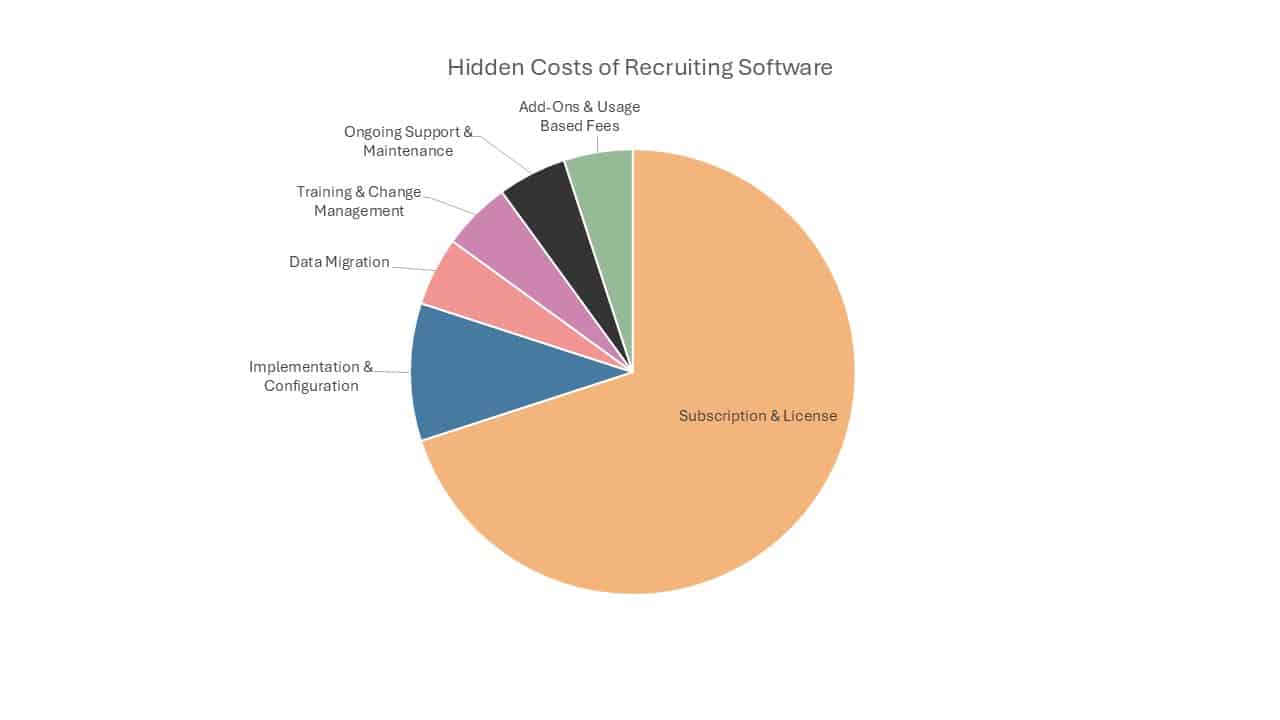
Many companies are surprised by additional costs tied to implementation, data migration, training, and ongoing support. On top of that, certain features—like advanced analytics or texting capabilities—may be sold as add-ons. When you combine these elements, it’s not unusual for the total cost to be 20–50% higher than the base price.
Do Integrations and Add-Ons Increase the Price?
Integrations and add-ons are one of the most common ways costs increase over time.
As your recruiting process matures, you may want to connect your software to background check providers, HRIS platforms, or job distribution tools. Each of these can carry an additional cost, and while they improve efficiency, they also raise your total investment.
This is where many teams underestimate long-term pricing, especially if they only focus on the base subscription during evaluation.
What Are You Actually Paying For with Recruiting Software?
Recruiting software is ultimately about efficiency and outcomes.
You’re paying to reduce manual work, shorten time-to-fill, and improve the experience for both candidates and hiring managers. When it works well, it allows your team to focus less on administrative tasks and more on making strong hiring decisions.
One helpful way to evaluate this is by comparing how much time your team spends on manual tasks today versus what could be automated.
How to Know If Recruiting Software Is Worth the Cost
The value of recruiting software shows up in results, not features.
If your team is filling roles faster, relying less on external agencies, and spending less time on repetitive tasks, the investment is doing its job. On the other hand, if adoption is low or workflows feel clunky, even an expensive platform can fall short.
Make a Smart, Cost-Confident Decision
Recruiting software is one of those investments where clarity upfront saves you time, money, and frustration later. You now have a clearer picture of what drives pricing, where hidden costs show up, and what you should expect based on your company’s size and hiring needs. That puts you in a much stronger position than most buyers when they start this process.
If you’re actively evaluating recruiting software or questioning whether your current system is worth the cost, the next step is to get a clear, tailored breakdown based on your situation.
If you want help cutting through the noise, our team at DISHER can bring clarity to your decision. We work alongside hiring leaders to evaluate recruiting software, identify gaps in the hiring process, and build systems that actually support your goals—not just your budget. Whether you’re starting from scratch or trying to get more out of your current tools, connect with us to get a practical, unbiased perspective on what will work best for your team.